
How to Structure High-Distinction Law Assignments in Australian Universities

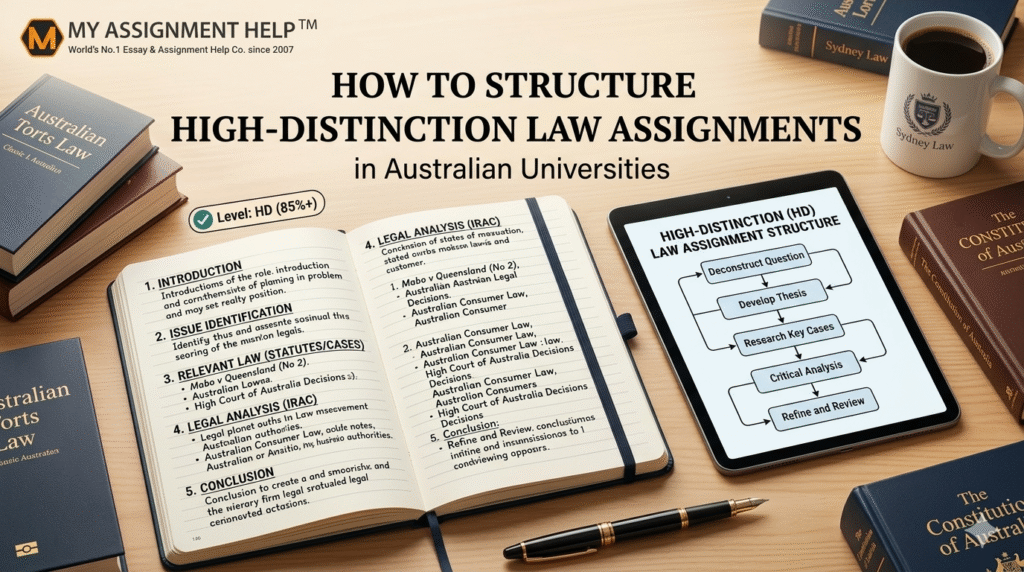
Navigating the rigorous academic landscape of Australian law schools requires more than just a deep understanding of statutes and case law. Whether you are studying at the University of Sydney, UNSW, or UQ, the difference between a “Pass” and a “High Distinction” (HD) often lies in the precision of your structural execution. In 2026, with the Australian Tertiary Education Commission (ATEC) emphasizing critical analytical skills over rote memorization, students must demonstrate a sophisticated command of legal synthesis.
The Australian legal education system is uniquely demanding. It requires a seamless blend of the AGLC4 (Australian Guide to Legal Citation) referencing style and the cognitive ability to apply abstract legal principles to complex, real-world fact scenarios. For many students balancing clerkships and intensive study loads, finding a reliable law assignment helper becomes a strategic decision to ensure their submissions align with these elite judicial standards.
Success in Australian law units—from Torts and Contracts to Constitutional Law—is built on a foundation of “legal logic.” If you are feeling overwhelmed by the sheer volume of precedents, you might think, “I need someone to do my assignment,” but understanding the architecture of a top-tier paper is the first step toward academic independence.
1. The Foundation: Mastering the IRAC/MIRAT Framework
The Gold Standard for Australian legal writing remains the IRAC method (Issue, Rule, Application, Conclusion). However, for an HD grade, top-tier universities now encourage the MIRAT variation:
- Material Facts: Identifying only the facts that carry legal weight.
- Issues: Precise phrasing of the legal questions.
- Rules/Relevant Law: Citing the correct Acts and High Court precedents.
- Argument/Application: The “heavy lifting” where you weigh opposing views.
- Tentative Conclusion: Providing a definitive yet nuanced resolution.
Data Insight: Why Structure Matters
According to internal marking rubrics from leading Go8 (Group of Eight) universities, “Structure and Logic” typically account for 20% to 30% of the total grade. A paper with brilliant insights but poor flow will rarely break the 75% barrier.
2. Advanced Application: The “Deep Dive” into Precedents
To achieve an HD, you cannot simply state the law; you must interrogate it.
- Statutory Interpretation: Always start with the text of the statute. In Australia, the Acts Interpretation Act 1901 (Cth) is your best friend. Mention the purposive approach—what was Parliament trying to achieve?
- Judicial Hierarchy: Ensure you are citing the highest possible authority. A High Court of Australia (HCA) decision on a point of law always trumps a Supreme Court decision from a specific state.
- Synthesizing Dissent: High-distinction students often reference “dissenting judgments” from landmark cases to show they understand the complexity and evolution of legal thought.
3. The AGLC4 Standard: Precision in Referencing
In Australia, there is no room for error with the Australian Guide to Legal Citation (4th edition).
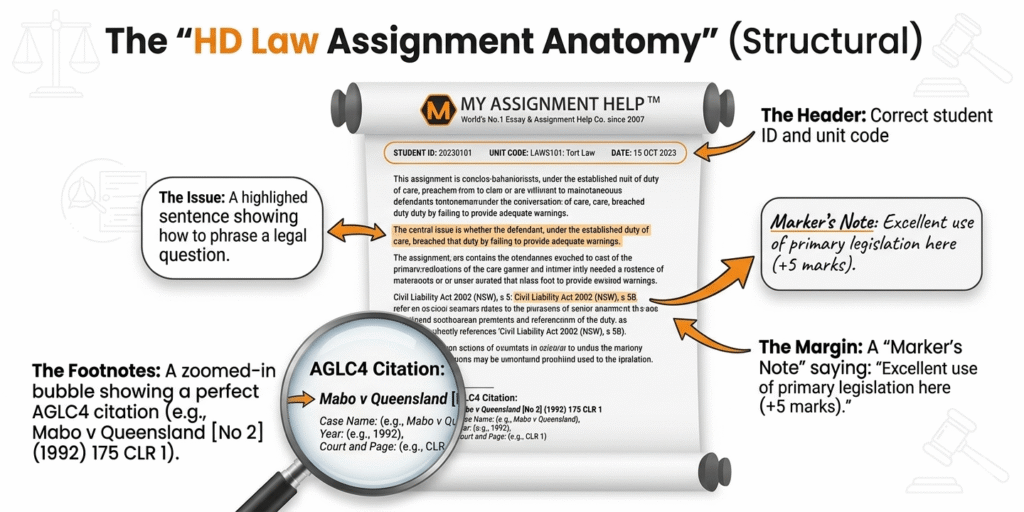
- Footnotes: Ensure every proposition of law is supported by a footnote.
- Pinpoint References: Don’t just cite a case; cite the specific paragraph or page number where the ratio decidendi (the reason for the decision) is located.
- Bibliography: Divide your bibliography into sections: A: Articles/Books/Reports, B: Cases, and C: Legislation.
Key Takeaways for HD Success
- Front-Load the Issue: Don’t keep the marker guessing. State the legal conflict clearly in the first paragraph.
- The 80/20 Rule: Spend 20% of your word count on the “Rules” and 80% on the “Application.” This is where the marks are hidden.
- Tone is Everything: Use formal, objective, and cautious language (e.g., “It is highly probable that…” rather than “It is certain that…”).
- Formatting: Use 1.5 or double spacing and clear headings to make the paper “scannable” for the marker.
See also: How to Conduct a Fire Risk Assessment Step by Step
FAQs: Legal Writing in Australia
Q: Can I use AI to write my law assignment in 2026?
A: Most Australian universities (like Monash and Melbourne Law School) have strict policies. While AI can help with brainstorming, the final legal synthesis and AGLC4 referencing must be human-verified to avoid “hallucinations” of non-existent cases.
Q: How many sources do I need for a 2,000-word law essay?
A: For an HD, aim for a minimum of 12–15 high-quality sources, including at least 5 primary sources (cases/legislation) and 7 secondary sources (peer-reviewed journal articles).
Q: Is the IRAC method mandatory?
A: It is not always mandatory, but it is highly recommended. It provides a “safety net” that ensures you don’t miss the crucial step of applying the law to the facts.
References & Sources
- Australian Guide to Legal Citation (4th ed, 2018).
- Acts Interpretation Act 1901 (Cth).
- Kirby, M., ‘On the Writing of Judgments’ (1990) 64 Australian Law Journal 691.
- Tertiary Education Quality and Standards Agency (TEQSA) – 2026 Guidelines on Academic Integrity.
About the Author: Dr. Alistair Vance
Dr. Alistair Vance is a Senior Academic Consultant at MyAssignmentHelp. With a PhD in Law from the Australian National University (ANU) and over 12 years of experience in legal practice and academic tutoring, Dr. Vance specializes in helping students navigate the complexities of Australian Administrative and Constitutional law. He has published numerous papers on pedagogical approaches to legal education and remains a key contributor to the MyAssignmentHelp academic excellence team.