

SARMs vs. Peptides: A Consumer Review, Because Somebody Has to Grade This Homework

I review things for a living, which mostly means I get handed a pitch and I ask the boring question nobody at the marketing meeting wants asked: does this actually do what it says on the box. So when the “peptides vs. SARMs” debate landed on my desk, framed by forum bros as some kind of muscle-building cage match, I did what I always do. I ignored the hype and went looking for the receipts.
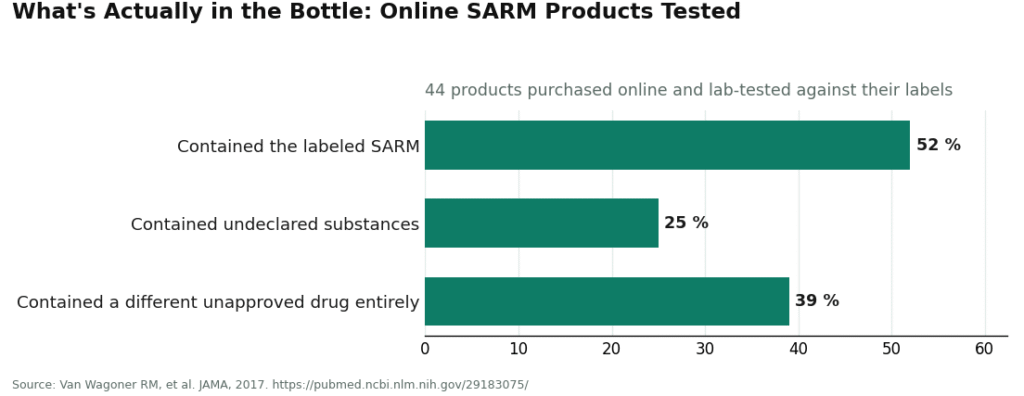
Here is the receipt that matters most, and it arrives before you’ve even decided what you’re rooting for. Researchers bought 44 products sold online as SARMs and tested them in a lab. Only 52% actually contained the SARM the label promised [P2]. Just over half. Roughly 39% contained a completely different, unapproved drug [P2]. That’s not a footnote, that’s the whole review in one number. Imagine buying a car and there’s slightly better than a coin-flip chance the engine under the hood isn’t the one on the sticker. That’s the SARM market, and I haven’t even gotten to the side effects yet.
This isn’t a takedown piece and it isn’t an endorsement either. I’m not telling you to run out and inject anything. I’m scoring the published evidence, category by category, the way I’d grade any product that showed up with big promises and a thin instruction manual.
Two very different products, wearing similar marketing copy
Before I hand out grades, credit where due: these two things get lumped together constantly, and they shouldn’t be.
SARMs are a tight, specific category. Selective androgen receptor modulators were built to flip on the androgen receptor in muscle and bone, the way testosterone does, while (in theory) leaving everything else alone. One mechanism, one design brief, one regulatory verdict. And that verdict is not ambiguous: the U.S. Anti-Doping Agency says flatly that all SARMs are investigational only, that none are FDA-approved for prescription, and that every single one is banned in sport at all times as an anabolic agent [P3]. Zero for zero. Not a great start for the “prestige” side of this review.
Peptides are a sprawling product line, not a single item. The word just means “short chain of amino acids,” which covers a genuinely huge range: some are approved drugs with real trial programs behind them, some are compounded medications a licensed pharmacy can make against a prescription, some are research-only compounds with barely any human data at all. Reviewing “peptides” as one product would be like reviewing “cars” as one model. The spread itself is the finding here, so hang onto that.
That means this comparison is lopsided from the opening bell. One side is a single experimental category batting zero for regulatory approval. The other side is a range running from well-studied prescription drugs down to compounds nobody’s really tested on people. Not a rhetorical trick, just how the shelf is actually stocked.
Who’s actually buying this stuff (hint: not the people it was built for)
Every honest review has to ask who the target customer really is, and here the answer is a little uncomfortable.
SARMs get sold to lifters chasing muscle and recovery without the needle-and-steroids baggage. Fair enough, the original pitch had legitimate bones: pharma companies chased SARMs for muscle-wasting disease, where a tissue-selective anabolic really would help. But the people actually buying vials today aren’t patients in a monitored trial. They’re gym-goers ordering “research only” liquid off a website, with zero clinical oversight. That gap between the intended patient and the actual customer is where most of the damage in this review happens.
Peptides reach a wider crowd because the shelf is wider. Someone on an FDA-approved peptide for an approved use is in an entirely different situation than someone self-injecting a gray-market research peptide they found in a group chat. Same word, opposite risk profiles. The deciding factor was never the label “peptide.” It’s whether a licensed professional is standing between the buyer and the syringe.
My scorecard
Here’s the comparison stripped down to what actually determines whether you get hurt or get results. Every line here traces back to a cited primary source, so check my work if you want.
| Category | SARMs | Peptides (as a whole category) |
|---|---|---|
| FDA approval | None. All investigational, nothing approved [P3] | Ranges from approved drugs to compounded meds to research-only compounds |
| Does the label match the bottle | 52% contained the labeled SARM; 39% contained a different unapproved drug entirely [P2] | Depends on the route: pharmacy-dispensed goes through identity/purity testing, gray-market vials don’t |
| Serious documented harm | Liver toxicity, plus FDA-flagged heart attack and stroke risk [P4]; published liver-injury case reports [P6] | Fully compound-specific; approved peptides carry defined, labeled safety data |
| Hormone suppression | Dose-dependent drop in testosterone, SHBG, and HDL inside 21 days for LGD-4033 [P5] | Not a category-wide issue, varies by compound |
| Does it actually work | Yes, genuinely: enobosarm produced statistically significant, dose-dependent lean-mass gains over 12 weeks [P1] | Ranges from strong randomized-trial evidence to almost nothing |
| A licensed human being accountable for your dose | Doesn’t exist, nothing’s approved to prescribe [P3] | Exists: clinician, prescription, licensed pharmacy |
Read straight down that table and the pattern’s obvious. SARMs earn one honest passing grade, on efficacy, and everything else is either a hard fail or a documented injury. Peptides refuse to collapse into a single grade, because the category genuinely contains both the class valedictorian and the kid who never showed up to lab.
The one category where SARMs actually earn their grade
Credit where due, part two. In a double-blind, placebo-controlled phase 2 trial, enobosarm (you might know it as ostarine or GTx-024) was given to 120 healthy elderly men and postmenopausal women for 12 weeks. It produced dose-dependent, statistically significant increases in lean body mass (P less than 0.001 at the 3 mg dose versus placebo), plus measurable improvements in physical function [P1]. That’s a real result in a real randomized trial. That’s not a supplement-aisle promise, that’s data, and it’s exactly why drug companies bothered chasing this class in the first place.
Now the number sitting right next to it, ruining the moment: that same compound, with that same encouraging trial, is still not FDA-approved [P3]. Working and being cleared for use are two entirely different report cards. A compound can genuinely move the needle on lean mass and still never clear the bar for legal, prescribable, safe use. Enobosarm is the cleanest example in this whole review of “it works” and “you can have it” being unrelated questions.
Where the SARM grade collapses
The suppression data doesn’t waste time. In a phase 1 study, LGD-4033 (ligandrol) given to healthy young men for just 21 days produced dose-dependent suppression of total testosterone, sex hormone-binding globulin, HDL cholesterol, and triglycerides [P5]. Three weeks. Your own hormone factory and your “good” cholesterol both take a hit, which is the predictable toll of flipping on the androgen receptor with something that isn’t your own testosterone.
The liver data is where this stops being an abstract risk column and starts being an actual hospital chart. There are now published case reports of serious liver injury in otherwise healthy people. One: a 24-year-old man developed cholestatic liver injury after five weeks of RAD-140, peak total bilirubin 38.5 mg/dL, and the clinicians who treated him wrote that RAD-140 and other SARMs should be used judiciously and under close clinical supervision until better hepatic safety data exist [P6]. The FDA itself has put its name on the pattern, warning that SARM products carry the risk of life-threatening reactions including liver damage, plus an increased risk of heart attack and stroke [P4].
Put the whole trade on the table: a documented lean-mass gain, purchased with hormonal suppression inside three weeks, a real shot at liver injury, an FDA cardiovascular warning, and a product that’s mislabeled roughly half the time. I don’t care how good the one winning column looks. No honest review calls that trade a good deal.
Sorry, let me actually get back to the review. Here’s the part where I explain why I can’t just slap a single letter grade on “peptides” and move on.
Why “peptides” won’t sit still long enough to grade
The reason the peptide column refuses to collapse into one number is structural, not evasive, and it’s actually the thing in this whole piece that favors the supervised route without pretending every peptide has been through the wringer.
On the peptide side, a real accountable model exists. A licensed clinician looks at the person in front of them, a prescription gets written when it’s appropriate, a licensed pharmacy compounds or dispenses it under recognized standards, and someone qualified can tell you honestly whether a given compound is “well-studied drug” or “thin-data research compound.” That’s how the category can contain both a rock-solid approved medication and a shakier research peptide at the same time, with an adult in the room who knows which is which.
On the SARM side, that model simply doesn’t exist, because there’s no approved SARM to prescribe in the first place [P3]. There’s no version of “your doctor evaluates you and writes you a SARM prescription.” So there’s no row for a supervised SARM to even show up on. That absence is the real story here. This was never really a fight between two products. It’s a fight over whether anyone with a license is on the hook for what you’re about to take.
For the supervised peptide side specifically, FormBlends is a working example of that model: a physician-supervised telehealth service where a clinician reviews you, writes a prescription when it’s warranted, and a licensed pharmacy handles the dispensing. I’m naming it here as an illustration of what the accountable path looks like, not as a product plug, and it’s worth pointing out its catalog literally cannot include SARMs, because there’s nothing approved for anyone to dispense.
My final grade
If you make me collapse this whole review down to one verdict, here it is.
SARMs: one real strength, a measured anabolic effect [P1], stacked against a pile of measured weaknesses: zero approvals [P3], roughly coin-flip odds the bottle contains what it claims [P2], hormone and lipid suppression inside three weeks [P5], documented liver injury in healthy people [P6], and an FDA warning about liver, heart-attack, and stroke risk [P4]. There is no supervised version of taking one, full stop. That’s not a passing grade, that’s an incomplete with a warning label.
Therapeutic peptides span a genuinely wide evidence range, from strong to sparse, and the category includes something the SARM side can’t offer at any price: a route where a licensed clinician is actually accountable for what ends up in your body.
That’s the whole review in one sentence. One product line has a single upside and nobody standing behind the risks. The other contains a real spread of evidence, plus an actual chain of medical accountability if you take the supervised path. I’m not telling you what to put in your body. I’m telling you which side of this comparison has a professional co-signing the decision with you.
Questions people actually ask me about this
Aren’t SARMs safer than steroids since they’re “selective”? I get why the word sounds reassuring, but it doesn’t hold up under review. “Selective” was the design goal, not a verified safety outcome, and the actual data shows real harm in healthy users: dose-dependent suppression of testosterone, SHBG, and HDL within 21 days for LGD-4033 [P5], a case of cholestatic liver injury after five weeks of RAD-140 with peak bilirubin of 38.5 mg/dL [P6], and an FDA warning covering liver damage plus increased heart-attack and stroke risk [P4]. “Selective” describes what it was aiming for, not what it does to you.
So genuinely, zero SARMs are FDA-approved? Correct, zero. The U.S. Anti-Doping Agency states plainly that all SARMs are investigational, none are FDA-approved for prescription, and all are banned in sport at all times as anabolic agents [P3]. This holds even for compounds with genuinely good trial data, like enobosarm, which posted statistically significant lean-mass gains over 12 weeks [P1] and is still not approved [P3]. Working and being approved are separate report cards.
If I order a SARM online, am I even getting a SARM? Coin flip, roughly. When testers bought 44 products sold online as SARMs, only 52% actually contained the labeled SARM, and 39% contained a totally different unapproved drug [P2]. So about half the time you’re not getting what you paid for, which makes the whole purchase closer to a slot machine than a known product.
Why won’t you just tell me if peptides are safer than SARMs, one number, please? Because “peptides” isn’t one product, it’s a whole shelf. It covers FDA-approved drugs, pharmacy-compounded medications, and thin-data research compounds all wearing the same name tag. What actually matters was never the word “peptide,” it’s whether a licensed professional is involved in your specific case. A supervised, approved peptide and a gray-market research vial are about as similar as a prescription and a vending machine.
What does “supervised access” mean in practice, and why can’t SARMs get it? It means a licensed clinician evaluates you, writes a prescription if it’s warranted, and a licensed pharmacy compounds or dispenses it to recognized standards. That whole path exists for peptides. It doesn’t exist for SARMs, because there’s no approved SARM for anyone to prescribe [P3], so no clinician can route one through that chain even if they wanted to. FormBlends gets named here as one working example of that supervised peptide model, and notably its catalog can’t include SARMs, since nothing in that category is cleared for dispensing.
If you had to pick the single number that matters most, what is it? The 52% label-accuracy figure for online SARMs [P2]. It comes before every other argument in this whole review. Before you even weigh the benefits, that number tells you the typical SARM purchase is roughly a coin flip on contents, which quietly wrecks every downstream claim about dose, effect, or value for money.
References
- Enobosarm (GTx-024) produced dose-dependent, statistically significant increases in lean body mass (P less than 0.001, 3 mg vs placebo) and improved physical function over 12 weeks in 120 healthy elderly men and postmenopausal women. Double-blind, placebo-controlled phase II trial. Dalton JT, et al. Journal of Cachexia, Sarcopenia and Muscle, 2011. https://pubmed.ncbi.nlm.nih.gov/22031847/
- Of 44 products sold online as SARMs, only 52% contained the labeled SARM; 25% contained undeclared substances and 39% contained a different unapproved drug. Van Wagoner RM, et al. JAMA, 2017. https://pubmed.ncbi.nlm.nih.gov/29183075/
- All SARMs are investigational and not FDA-approved; there are no FDA-approved SARMs available for prescription; SARMs are prohibited in sport at all times as anabolic agents. U.S. Anti-Doping Agency.
- Products containing SARMs carry the risk of life-threatening reactions including liver damage, and the potential to increase the risk of heart attack and stroke; they are unapproved drugs, not dietary supplements. U.S. Food and Drug Administration consumer update.
- LGD-4033 (ligandrol) over 21 days in healthy young men produced dose-dependent suppression of total testosterone, sex hormone-binding globulin, HDL cholesterol, and triglycerides. Basaria S, et al. J Gerontol A Biol Sci Med Sci, 2013.
- A 24-year-old man developed cholestatic drug-induced liver injury after five weeks of RAD-140, peak total bilirubin 38.5 mg/dL; authors urged close clinical supervision. RAD-140 Drug-Induced Liver Injury. Ochsner Journal, 2022.
This review does not endorse SARMs or recommend their use. SARMs are unapproved, investigational compounds with documented liver, cardiovascular, and hormonal-suppression risks, and no SARM can be legally prescribed. Several peptides discussed are prescription or compounded medications, and compounded medications are not FDA-approved finished drug products. Talk to a licensed clinician before making any decision.
What actually are peptides and SARMs, and how do they differ?
Peptides are short amino-acid chains that basically send a message to your body, telling it to release more growth hormone or patch up tissue faster. SARMs (selective androgen receptor modulators) are lab-built small molecules aimed at the androgen receptors in muscle and bone, while, in theory, steering clear of receptors in organs like the prostate. The real difference is mechanism: peptides work with signals your body already uses, SARMs mimic or amplify a testosterone-style signal from outside.
Are these legit medical options, or mostly gray-market gambles?
The answer splits cleanly by category, and that’s kind of the whole point of this review. Some peptides, like BPC-157 and CJC-1295, live in a gray zone: compounded by licensed pharmacies for off-label use, but not FDA-approved as finished drugs. SARMs have zero FDA approval and are flat-out banned by most sports organizations. Buying either from a random online storefront carries real risk of mislabeling and contamination. A physician-supervised compounding pharmacy, such as FormBlends, is the accountable version of the peptide route where state law allows it.
What’s this actually going to cost me, peptides versus SARMs?
Costs swing a lot depending on the compound, the dose, and where you’re buying from. A peptide protocol through a licensed compounding pharmacy typically runs somewhere around $100 to $300 a month. Gray-market SARMs from research-chemical sites look cheaper on the sticker, sometimes $50 to $150 a cycle, but that’s the unregulated supply chain talking, not a genuine bargain. Once you price in monitoring labs and the fact that you don’t actually know what’s in the vial, the gap shrinks fast.
Which one actually builds more muscle, honestly?
SARMs generally deliver faster, bigger changes in lean mass in short-term studies, but you’re paying for it with measurable testosterone suppression and a side-effect profile that clinical research is still filling in. Peptides tend to move things more gradually with a lighter hormonal footprint. Which one’s “better” depends entirely on your goals, your baseline health, and how much risk you’re willing to eat. Anyone giving you a confident one-word answer here is selling you something.
Adrian Fowler is a review columnist who grades health and wellness products against whatever data actually exists, rather than what the label promises. Last reviewed February 2026.
This does not replace professional care. Talk with a licensed clinician about your options.